
What good cybersecurity maturity looks like in practice
A lot of organisations talk about cybersecurity maturity as though it were a score. That is usually where the misunderstanding starts.
In practice, good maturity is not a high mark on an index, an assessment, or an audit heatmap. It is a security function that knows what matters most, protects it proportionately, and can show that its controls, people, and spending are aligned to how the business actually runs.
That is a different test altogether.
The problem with many maturity discussions is that they reward what is easy to count. Policies published. Controls mapped. Committees held. Reports produced. Audit findings closed. These things are not irrelevant, but they are also not the same as maturity. They show activity more easily than they show control. They often reflect how well an organisation prepared for the review rather than how well it actually operates under pressure.
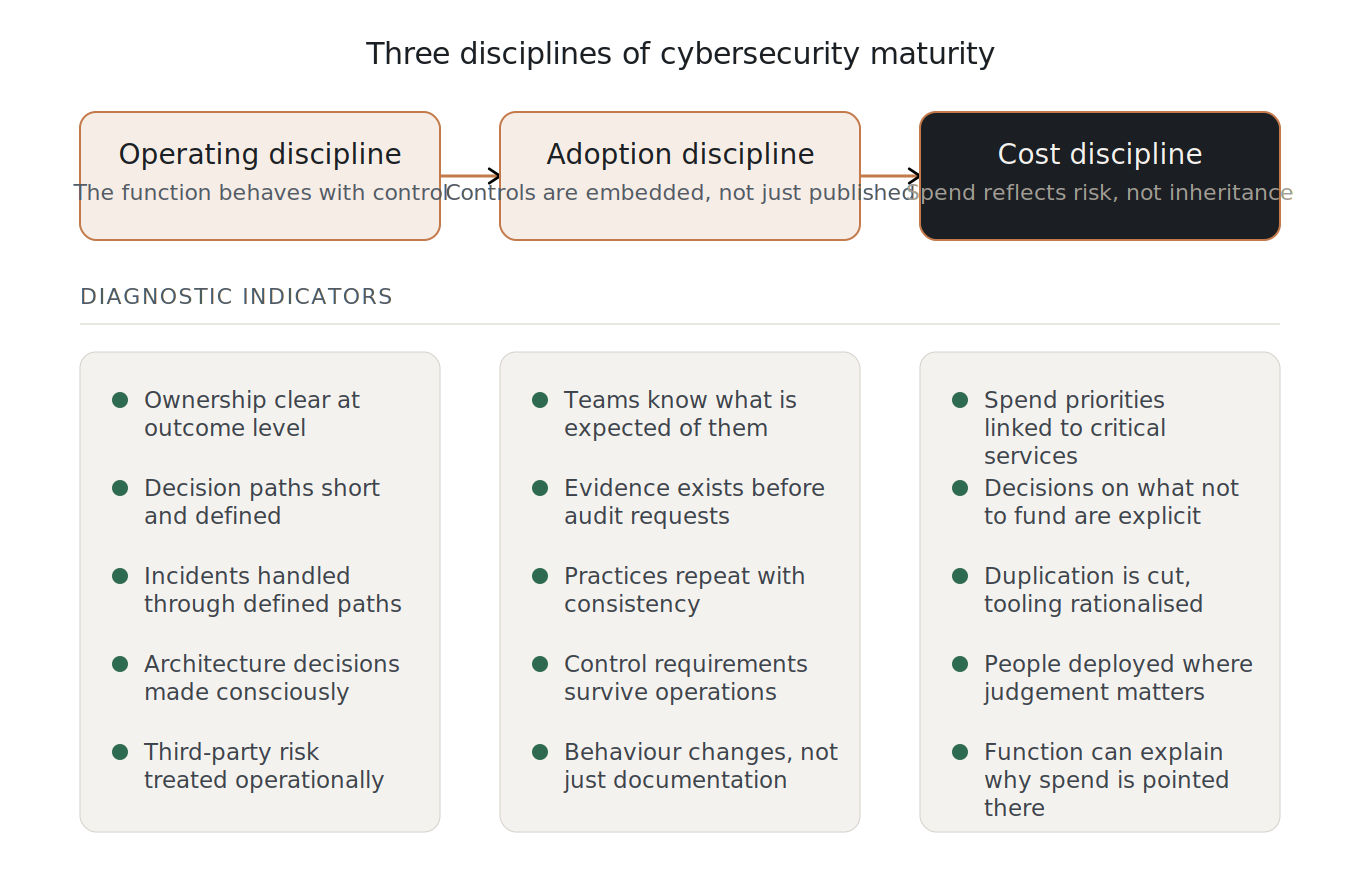
That matters especially in retail, manufacturing, and industrial businesses. These are commercially pressured, operationally uneven environments full of dependencies across plants, warehouses, engineering teams, customer channels, suppliers, and legacy systems. In that setting, good maturity is less about theoretical control coverage and more about discipline in three specific areas.
Start with the business, not the model
A mature security function starts with the business model.
In retail, that usually means stores, e-commerce, payments, pricing, fulfilment, identity, and supplier connectivity. In manufacturing and industrial businesses, it is more likely to mean plant continuity, engineering change, production systems, maintenance access, recovery of critical operations, and safety-related dependencies.
A mature function knows which services matter most to revenue, continuity, safety, and trust. It understands the dependencies underneath them. It knows where disruption would hurt most, where third parties create real risk, and where recovery would be hardest.
That may sound obvious, but it is where many maturity conversations go off course. Organisations end up asking how mature they are in the abstract when the better question is simpler: do we understand what matters most, and are we protecting it in a way the business can sustain?
Good maturity is operating discipline
Once criticality is clear, maturity starts to show up in how the organisation behaves.
The strongest security functions are usually not the noisiest ones. They tend to look calmer. Ownership is clearer. Priorities are easier to explain. Decision paths are shorter. Incident escalation is better rehearsed. Architecture decisions are made consciously rather than inherited by accident. Third-party risk is treated as an operational dependency, not just a contractual one.
The business knows who owns what. Teams know how decisions are made. Exceptions are visible rather than informal. Critical access is controlled the way leadership believes it is controlled. Incidents are handled through defined paths rather than heroics. Recovery is understood before it is needed.
Good maturity is adoption discipline
This is the point many assessments miss.
A control is not mature because it exists in a policy. It is mature when it has been adopted consistently enough that the organisation can rely on it.
That means people understand what they own. Teams know what is expected of them. Control requirements are usable enough to survive contact with day-to-day operations. Evidence exists before anyone starts reconstructing it for an audit. Important practices are repeated with enough consistency that leadership can assume they will happen when needed.
This is why maturity scores are often misleading. A review can confirm that a process exists. An audit can confirm that a standard has been published. None of that proves that the process is embedded deeply enough to shape behaviour.
If the business has to be dragged back into the same control every quarter, if ownership remains blurred, or if incident response still depends on improvisation, the function is probably less mature than the score suggests.
Good maturity is cost discipline
One of the quickest and clearest ways to assess maturity is to follow the money.
A mature security function should be able to explain what it is spending on, why, and what risk that spend is reducing. It should be able to show where investment is improving resilience, and where spend would only add noise.
That usually tells you more than dashboards, control counts, or reporting layers.
The most mature teams show a consistent pattern. Spend priorities are linked to critical services. Decisions on what not to fund are explicit. Investment is concentrated where it improves continuity, safety, resilience, recovery, or trust. Duplication is cut. Tooling is rationalised. Governance is proportionate. People are deployed where specialist judgement matters most, not where legacy structures happened to leave them.
Good maturity is selective, not maximal
One of the clearest signs of immaturity is the attempt to raise everything at once.
That usually leads to broad control expansion, larger reporting packs, more governance layers, and more noise. It creates the appearance of seriousness, but not necessarily better protection.
A mature function does not try to make every area equally advanced. It knows where deeper capability is justified and where a simpler baseline is enough. It accepts that not every system, site, process, or supplier needs the same level of attention.
Good maturity means making those distinctions deliberately. Stronger control where continuity, safety, revenue, recovery, or trust depend on it. The discipline not to over-engineer the rest.
The practical test
The practical test is simple.
Can the function explain which services matter most, which risks matter most to those services, what controls and capabilities are in place, who owns them, how they are tested, how incidents would be handled, and why the current spend is pointed there rather than elsewhere?
If it can, maturity is probably real. If it cannot, a high score will not rescue it.
Good cybersecurity maturity is not about looking advanced on paper. It is about becoming more deliberate in practice. Stronger operating discipline, cleaner cost discipline, better adoption of the controls that matter, and clearer alignment between security effort and business criticality.
The real sign of maturity is simpler: the function knows what matters, funds what matters, and can show that the business is better protected because of it.
Next in this series: NIS2 compliance for UK businesses with EU operations — why a federated model works better than a central compliance machine, and how to avoid unnecessary cost.