
Operational drift in cyber: why performance weakens before cost becomes visible
Operational drift shows up in performance first. Cost follows behind.
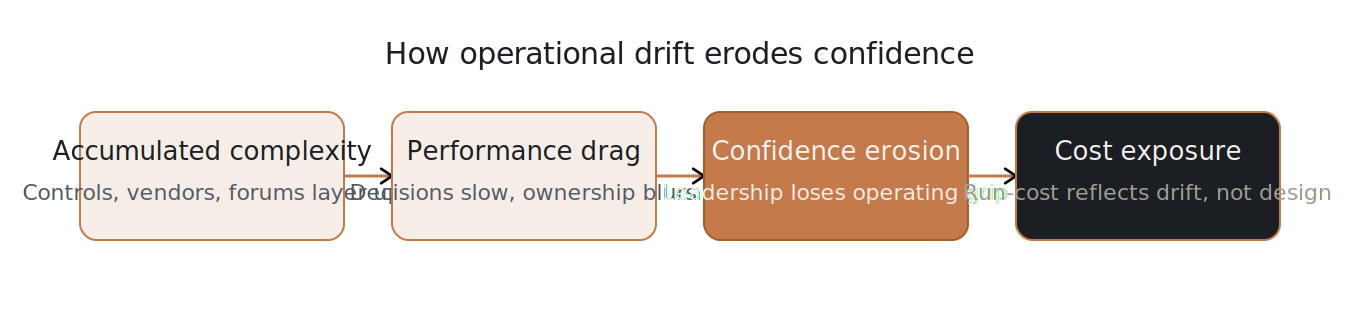
In cyber, it rarely begins with a dramatic failure. It builds gradually.
A control is added, but nothing is removed. A governance forum is introduced, but never retired. A vendor solves a real problem, but the overlap it creates is left in place. A new role closes a gap, while the underlying accountability remains unresolved.
Individually, these decisions look reasonable. Over time, they change how the function behaves. Decision-making slows, ownership becomes less clear, and issues that should be manageable start requiring too much coordination.
That is usually when leadership notices. Not because spend is suddenly visible, but because the function no longer appears to have the level of grip its structure and cost should imply.
What drift looks like in practice
The first signs are usually operational.
A remediation plan stays open because it runs across several teams and no one owns the end-to-end outcome. An incident takes longer to contain because responsibilities are split across security, infrastructure, engineering, and third parties. A regulatory commitment or business-critical request triggers extensive internal coordination, but limited forward movement.
This is the pattern boards and operating partners should pay attention to. The problem is not simply delay. It is delay combined with ambiguity. A well-run function can face pressure and still remain legible. A drifting one becomes harder to read at exactly the point the business most needs clarity.
A closer look usually reveals familiar patterns. Tooling acquired for a specific moment was never properly reassessed. Control activity has been layered on top of earlier control activity without removing what it was supposed to replace. Governance forums review and escalate, but do not decide. Reporting creates visibility, but not accountability.
The function may still contain strong people and sound intentions. That is not the issue. The issue is that the operating model has become harder to rely on than the business should tolerate.
Why it matters commercially
For boards, CIOs, and operating partners, the core issue is confidence.
Can the function absorb change without becoming unstable? Can it support an acquisition, a separation, a regulatory deadline, or a major incident without disproportionate management attention? Can it explain, plainly, who owns what, how decisions are made, and where escalation is genuinely required?
When the answer becomes unclear, the consequences extend well beyond cyber.
Leadership time is pulled into coordination that should not require executive involvement. Change slows because the route from issue to decision has become too crowded. Run-cost increases without a corresponding improvement in resilience, assurance, or delivery. In a transaction context, the same ambiguity creates diligence friction: unclear accountability, uneven evidence, duplicated activity, and a cost base that looks inherited rather than designed.
That is why operational drift should not be treated as an internal housekeeping problem.
It creates commercial drag. It raises the cost of management attention. It weakens assurance readiness. It complicates integration and transformation. It increases the risk that a containable issue becomes a broader leadership concern because the function cannot respond with speed and clarity. By the time the budget line is being questioned directly, the business has often already been paying in slower execution, weaker confidence, and avoidable friction.
The common mistake
Many organisations respond too heavily and too late.
Once leadership sees that the function is harder to operate than expected, the instinct is often to launch a broad transformation programme: redesign the operating model, reset governance, add workstreams, re-document services, and create new programme layers around the issue.
That can produce a cleaner description of the problem without materially improving how the function runs.
For boards and operating partners, that is the key distinction.
What a credible response looks like
A credible response is not defined by the size of the programme around it. It is defined by whether it restores clarity, accountability, decision quality, and operating headroom quickly enough to matter.
A credible response to drift should be judged against a small number of practical tests.
First, it should explain how the function actually runs, not merely how the structure is described on paper. The relevant question is whether material outcomes have clear owners, whether decision rights sit at the right level, and whether the model can operate at speed without repeated escalation.
Second, it should show clear outcome-level accountability. In drifting functions, activity is often allocated, but results are not fully owned. Boards do not need reassurance that tasks are being performed in fragments. They need assurance that important outcomes are genuinely held.
Third, it should show that governance improves decision-making rather than simply observing activity. A forum that reviews and escalates but does not decide is more often a sign of accumulated residue than of mature oversight.
Fourth, it should demonstrate that the control and vendor landscape still reflects deliberate design. A credible model can explain why each major control, service, and dependency still earns its place. A weak one usually cannot.
Finally, it should aim for proportional reset rather than symbolic transformation. The test is whether the response restores operating grip: clearer ownership, cleaner decision rights, fewer unnecessary hand-offs, lower avoidable run-cost, and enough headroom for the function to respond when the business needs it.
That is the standard against which any proposed intervention should be judged.
Six signs leadership should recognise
A cyber function may be drifting if several of the following are true:
- Containable issues repeatedly require executive attention.
- Ownership cannot be explained simply at outcome level.
- Governance forums review extensively but decide little.
- Reporting has improved, but accountability has not.
- Run-cost rises, yet the function does not look faster, clearer, or more resilient.
- Under pressure, the model produces friction before it produces action.
Any one of these can happen in a healthy organisation. A cluster of them usually points to something more structural.
When to act
The right time to deal with drift is before it is exposed by failure.
Before the incident that takes too long to contain. Before the audit issue that becomes a broader judgement on operating grip. Before transaction pressure, regulatory scrutiny, or executive frustration forces intervention on less favourable terms.
At that earlier stage, leadership still controls the pace and shape of the response. The organisation can address the issue as a deliberate reset rather than a reactive correction.
Once drift becomes visible through failure, the cost rises sharply. The business is no longer dealing only with accumulated complexity. It is dealing with accumulated complexity and weakened confidence at the same time.
Operational drift in cyber is rarely first noticed as a budget problem. It is usually noticed as a confidence problem, a control problem, or a delivery problem. By the time cost is receiving direct scrutiny, the operating model has often been under strain for some time.
That is why the practical question for boards and operating partners is not whether the function is active. It is whether it still has clear grip over the outcomes that matter.
Next in this series: NIS2, DORA, and the UK Cyber Security and Resilience Bill — what these converging regulatory frameworks mean for boards, and why governance discipline matters more than compliance checklists.